

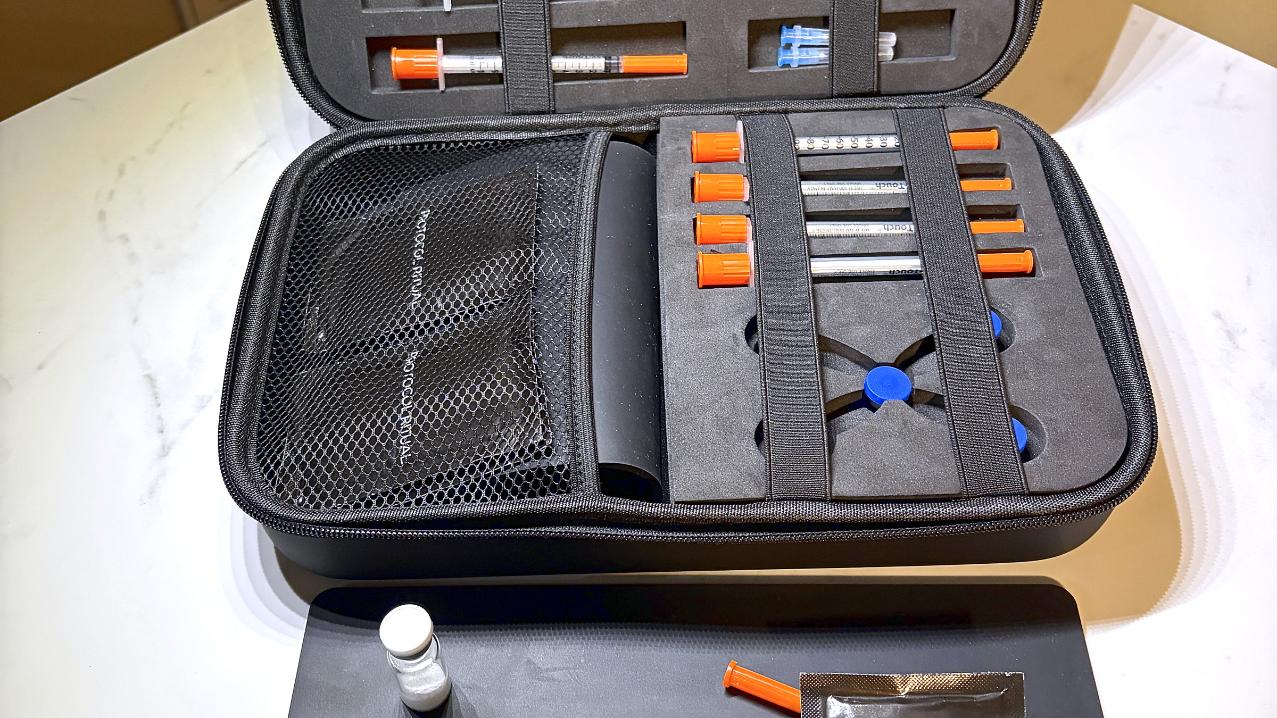
Flying with TRT or prescribed peptides is generally permitted in the United States, including when your supplies involve injectable medication, vials, and unused syringes. The key is understanding the TSA rules for syringes and vials, keeping your medication identifiable, declaring injectable supplies at the checkpoint, and following the storage instructions provided by your prescriber, pharmacist, and medication manufacturer. TSA allows unused syringes when they are accompanied by injectable medication, but travelers must declare them to the security officer for inspection. TSA also recommends clearly labeling medications to make screening easier.
Traveling with a protocol does not have to mean dropping loose syringes, alcohol prep pads, and medication boxes into a plastic bag. A little preparation can make the process more discreet, organized, and predictable. This guide explains how to pack TRT and peptide supplies for a flight, what to expect at airport security, how medically necessary liquids are handled, and what additional steps may apply during international travel.
Quick answer: You can generally bring prescribed injectable medication, vials, and unused syringes through a TSA checkpoint. Keep the syringes with the injectable medication, tell the TSA officer about them before screening, and place medically necessary medication and related accessories where they can be inspected separately.
Can You Bring TRT and Peptides on a Plane?
In general, TSA permits medications in both carry-on and checked baggage. Medically necessary liquid medications can also exceed the standard 3.4-ounce or 100-milliliter carry-on limit when brought in reasonable quantities for the trip. These medications must be declared to TSA officers and may receive additional screening.
That means a traveler may generally carry prescribed testosterone or peptide medication along with the supplies required to administer it. However, TSA screening rules are only one part of the equation. You must also consider:
- Whether the medication was legally prescribed to you
- Whether the medication is permitted at your destination
- The airline’s baggage policies
- The storage requirements listed by the pharmacy or manufacturer
- Customs rules when entering another country
- Rules that apply when returning to the United States
TSA determines whether an item can pass through a U.S. airport security checkpoint. It does not guarantee that another country will allow the same medication through customs.
This distinction is especially important for peptides. The term “peptides” can refer to many different products with very different regulatory statuses. Travel only with medication that is lawful for you to possess and use. Do not assume that a product sold online, discussed in a private group, or commonly used within a fitness community is legal to carry domestically or internationally.
What Are the TSA Rules for Syringes?
TSA states that unused syringes are allowed in carry-on and checked bags when they are accompanied by injectable medication. Travelers must declare the syringes to security officers at the checkpoint so they can be inspected. TSA recommends, but does not require, medication labeling to help facilitate the process.
For the smoothest screening experience, keep your unused syringes together with the medication they support. Avoid scattering them among unrelated toiletries, clothing compartments, or loose pockets.
A practical syringe-packing setup may include:
- Unused syringes in sealed manufacturer packaging
- Injectable medication in its labeled vial or pharmacy packaging
- A copy of the prescription or pharmacy documentation
- Alcohol prep pads
- A compact sharps container or another appropriate puncture-resistant disposal solution
- Any additional supplies specifically recommended by your provider
Do not prefill syringes for travel unless your prescriber or pharmacist has specifically instructed you to do so. Prefilled syringes may be more difficult to identify, can complicate storage, and may not be appropriate for every medication.
Should TRT and Peptides Go in a Carry-On or Checked Bag?
For most travelers, carrying essential medication in a carry-on is the more dependable approach. Checked luggage can be delayed, misrouted, exposed to temperature extremes, or become inaccessible during a long travel day.
Keeping your protocol supplies in your carry-on provides several advantages:
- Your medication remains under your control.
- You can present it directly during TSA screening.
- You still have access if checked baggage is delayed.
- You can better monitor how the supplies are handled.
- You can separate medication from items that could damage vials or packaging.
TSA permits unused syringes with injectable medication in both carry-on and checked baggage, but permission does not eliminate the practical risks associated with checking important medication.
Pack only a reasonable amount for the trip, along with a modest contingency supply when your prescriber or pharmacist considers that appropriate. Carrying a large quantity without clear documentation may attract additional questions, particularly during international travel.
Do Vials Have to Follow the TSA 3-1-1 Liquids Rule?
Medically necessary liquid medication is not limited in the same way as ordinary toiletries. TSA allows medically necessary liquids, gels, and aerosols in quantities greater than 3.4 ounces or 100 milliliters when they are reasonable for the trip. You must declare them to the TSA officer for inspection.
Most TRT and peptide vials are already well below 100 milliliters. Even so, travelers should not hide them inside the standard toiletries bag. It is better to keep injectable medication together in a clearly organized area that can be removed for screening.
Before screening begins:
- Tell the TSA officer that you are carrying medically necessary injectable medication.
- Remove the medication and related supplies if instructed.
- Place them in a separate bin or bowl.
- Keep syringes with the medication they are intended to administer.
- Allow extra time for visual inspection, X-ray screening, or other testing.
TSA notes that medications may undergo visual or X-ray screening and may be tested for traces of explosives. Accessories associated with liquid medication, including freezer packs, pumps, IV bags, and syringes, should also be presented separately.
Do Medications Have to Be in Their Original Packaging?
TSA recommends that medication be clearly labeled, but federal TSA screening guidance does not universally require every medication to remain in its original prescription container. Clear labeling can nevertheless reduce confusion and make it easier to establish what the vial contains.
A well-prepared traveler may carry:
- The medication in its original pharmacy-labeled container
- The original medication box, when practical
- A printed or digital copy of the prescription
- A pharmacy receipt or medication summary
- A brief provider letter for international or extended travel
For domestic U.S. travel, documentation may never be requested. Bringing it is still a reasonable precaution, particularly when traveling with multiple vials, controlled medication, syringes, or supplies that are unfamiliar to a screening officer.
State laws can also differ, so original labeling is a sensible practice even when TSA does not mandate it.
How to Pack TRT and Peptide Supplies for Airport Security
An effective travel setup should prioritize identification, protection, discretion, and accessibility.
Keep Related Supplies Together
Create one dedicated system for your protocol instead of distributing supplies throughout your luggage. Place the medication, unused syringes, alcohol prep pads, and documentation in defined compartments.
The goal is not merely to make the bag look cleaner. It is to prevent:
- Vials from moving freely
- Syringe packaging from becoming crushed
- Alcohol prep pads from disappearing into luggage
- Documents from being separated from medication
- Personal protocol supplies from mixing with ordinary toiletries
Protect Vials From Impact
Keep vials upright when possible and away from hard objects that could strike or crush them. Do not place a vial loose beside charging blocks, metal grooming tools, shoes, or other heavy travel items.
A structured case can help with organization and physical separation, but travelers must still follow all medication-specific handling instructions.
Keep Documentation Accessible
Do not bury your prescription information at the bottom of a suitcase. Store it in the same section as the medication or in an immediately accessible document pocket.
You may not need to show it, but you should be able to retrieve it without unpacking your entire carry-on at the checkpoint.
Do Not Pack Loose Sharps
Unused syringes should remain capped and, ideally, sealed in their original packaging. Used sharps require appropriate containment and disposal. Never place a used needle loose in a travel case, toiletry bag, seat pocket, hotel trash can, or carry-on compartment.
Ask your pharmacy or healthcare provider about an appropriate travel sharps container before departure. Disposal rules can differ by location, so confirm what is permitted at your destination.
What Happens at the TSA Checkpoint?
The process is usually straightforward when your supplies are consolidated and declared.
Before your medication enters the screening system, tell the officer that your bag contains injectable medication and unused syringes. TSA advises travelers to place medically necessary liquids, medications, and related accessories in a separate bin or bowl.
An officer may:
- Inspect the medication visually
- Send the case through X-ray screening
- Swab the exterior of the container
- Ask you to identify the medication
- Request that an item be screened separately
- Refer the question to a supervisor
Remain calm and answer directly. You do not need to explain your entire treatment history. A simple statement such as, “This is prescribed injectable medication with unused syringes,” is usually enough to identify the items.
The final decision about whether an item is allowed through the checkpoint rests with the TSA officer.
Travelers who anticipate needing additional screening assistance can contact TSA Cares before departure. TSA Cares provides help for passengers with medical conditions and other special circumstances.
How to Handle Medication That Requires Temperature Control
Some injectable medications have specific temperature ranges, while others may have limited allowances for room-temperature storage. Requirements vary by medication, formulation, pharmacy, and manufacturer.
Always follow the instructions supplied with your medication and confirm uncertain storage questions with your pharmacist or prescriber. Do not use a generic internet temperature range as a substitute for the directions associated with your specific prescription.
When cooling is medically necessary, TSA permits medically necessary gel packs in reasonable quantities, even when they are partially melted or slushy. These items should be declared and presented for screening with the medication.
A few important planning points:
- Confirm the exact storage range before departure.
- Ask how long the medication may remain outside refrigeration.
- Avoid placing medication directly against a frozen pack unless the manufacturer or pharmacist says that is appropriate.
- Prevent accidental freezing.
- Consider the full door-to-door travel time, not only the flight duration.
- Confirm refrigerator access at the destination when required.
- Do not leave medication in a parked vehicle.
Protocol Ritual’s current case is an organization and preparation system. It does not include a cooling or cold-chain system and should never be treated as a temperature-control device. Travelers whose medication requires cooling need a separate solution that meets the instructions provided by their pharmacist, prescriber, or manufacturer.
Domestic Travel vs. International Travel
Traveling within the United States generally centers on TSA screening, airline policies, state law, and proper medication handling. International travel adds customs and destination-country regulations.
A medication that is legally prescribed in the United States may be restricted, classified differently, or prohibited elsewhere. Before flying internationally:
- Check the destination country’s embassy or consulate guidance.
- Confirm whether advance authorization is required.
- Ask whether syringes or controlled medications require a provider letter.
- Carry medication in original packaging.
- Bring only the amount reasonably needed for the trip.
- Keep the prescription in the traveler’s name.
- Research rules for every country on the itinerary, including connections.
U.S. Customs and Border Protection advises international travelers to keep medications in their original packages, bring only the amount needed, and ensure prescription medication is under the traveler’s name. CBP also notes that country-specific document and entry requirements may apply.
When returning to the United States, additional documentation may be relevant, including a prescription copy or provider letter, particularly when the medication was acquired abroad.
TSA approval at the departure airport does not override customs law at the destination.
Common Mistakes When Flying With TRT
Hiding Syringes Deep in Your Luggage
Trying to make syringes less noticeable can create a more confusing inspection. Keep them organized with the injectable medication and declare them.
Checking All Medication
Placing the entire supply in checked baggage creates avoidable exposure to delays, loss, and temperature fluctuations.
Removing Every Label
A completely unmarked vial may be harder to explain. Keep the pharmacy label, prescription box, or supporting documentation whenever possible.
Assuming Every Peptide Is Treated the Same
Different products can have different legal, storage, and documentation requirements. Confirm the status of the exact medication you plan to carry.
Improvising Temperature Control
A cold drink, hotel ice bucket, or frozen pack placed directly against a vial is not automatically an appropriate cold-chain solution. Follow medication-specific instructions.
Forgetting About the Return Trip
Plan for used-sharps disposal, remaining medication, hotel storage, customs inspection, and the trip home before departure.
A Practical Preflight Checklist
Before leaving for the airport, confirm that you have:
- Prescribed medication in identifiable packaging
- Unused syringes stored with the injectable medication
- Alcohol prep pads
- Appropriate sharps containment
- Prescription or pharmacy documentation
- A provider letter when recommended
- Enough supplies for the trip and reasonable delays
- Medication-specific storage instructions
- A separate compliant cooling solution when medically required
- Destination-country approval for international travel
- Supplies placed in an accessible carry-on compartment
Frequently Asked Questions
Can I take testosterone and syringes through TSA?
Yes. TSA allows unused syringes when accompanied by injectable medication. Declare the medication and syringes to the TSA officer for inspection.
Can I carry peptide vials in my carry-on?
Generally, prescribed liquid medication may be carried in a carry-on bag. Declare medically necessary liquids and present them separately when instructed.
Do injectable medications have to be under 3.4 ounces?
No. TSA allows medically necessary liquids over 3.4 ounces or 100 milliliters in reasonable quantities for the trip, but they must be declared for screening.
Do I need a doctor’s letter to fly with TRT?
TSA does not generally list a provider letter as a universal requirement for domestic screening. However, carrying a prescription copy or a provider letter can help, especially for international travel.
Should medication go in my checked bag?
It may be permitted, but essential medication is generally more accessible and easier to monitor in a carry-on. TSA allows unused syringes with injectable medication in either carry-on or checked bags.
Can I travel with gel ice packs for medication?
Yes. TSA permits medically necessary gel ice packs in reasonable quantities, including when they are melted or slushy. Declare them for inspection.
Does the Protocol Ritual case keep medication cold?
No. The current Protocol Ritual case does not include a cooling or cold-chain system. It is designed for organization, discretion, and preparation. Use a separate temperature-control solution when required by your medication instructions.
Can I fly internationally with peptides?
That depends on the specific medication and the laws of each country on your itinerary. Check embassy, consulate, airline, and customs guidance before traveling.
Bring Order to Your Protocol
Travel exposes every weak point in a disorganized routine. Loose syringes, unprotected vials, missing alcohol prep pads, and supplies scattered across multiple bags create unnecessary friction before you ever reach the security line.
Protocol Ritual was built for people who take their routine seriously and want the tools around it to reflect that. We are here for daily users who are tired of piecing together a process from random supplies and are tired of pretending that messy setups are good enough.
With a discreet premium case, a real weighted prep mat, and custom-branded alcohol prep pads included, Protocol Ritual is the first all-in-one kit designed to support the full ritual from organization through preparation. The current case is not a cooling or cold-chain system, so medication storage must always follow the instructions provided by your pharmacist, prescriber, and manufacturer.
Join the Protocol Ritual launch and be the first to experience a better standard for daily protocol.