

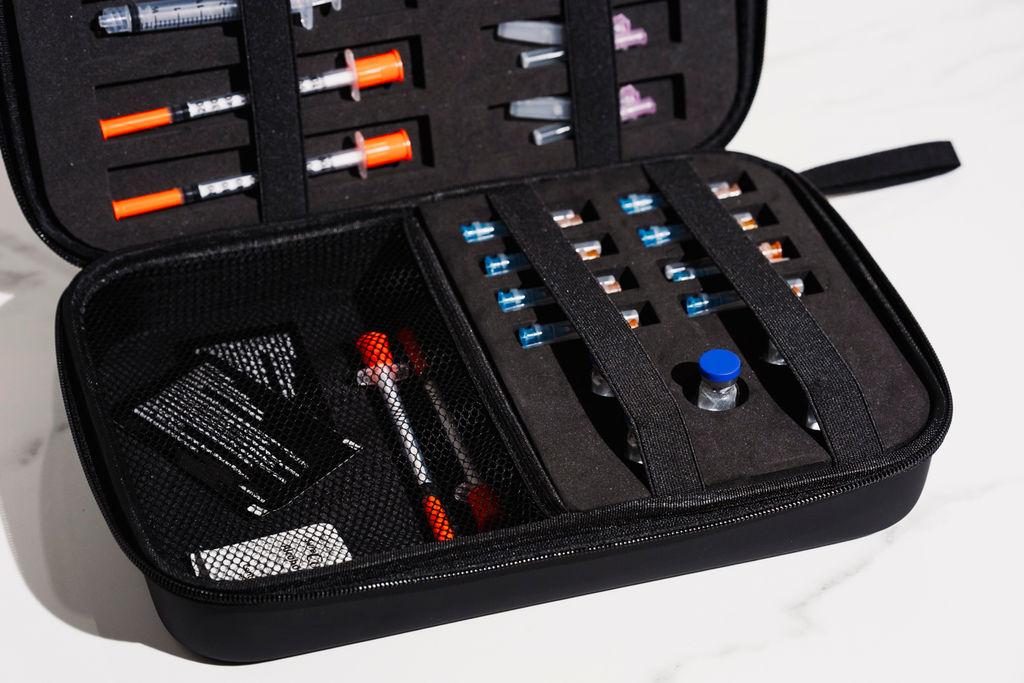
Learning how to store Ozempic, how to store semaglutide, and how do you travel with Ozempic starts with separating two responsibilities: protecting the medication according to its official instructions and organizing the supplies around it. A well-planned system can keep pens, alcohol prep pads, travel documents, and supporting items orderly, but an organizer is not automatically a refrigerator, cooler, or temperature-control device. Protocol Ritual’s current case does not include a cooling or cold-chain system. Any medication that requires refrigeration or temperature management must be handled with an appropriate separate solution based on the manufacturer’s instructions and guidance from your pharmacist.
For people managing a recurring at-home injection routine, storage and travel can become unnecessarily complicated. Pens end up in different drawers. Alcohol prep pads disappear into toiletry bags. Packaging gets discarded before important storage information is recorded. Travel days introduce heat, airport screening, luggage handling, and schedule changes.
The answer is not to turn your routine into a medical supply warehouse. It is to create a repeatable system that distinguishes medication storage from supply organization.
Start With the Instructions for Your Exact Product
Semaglutide is available in different products and device formats. Do not assume that storage directions for one pen, syringe, or package apply to another simply because they contain the same active ingredient.
Before creating a storage or travel plan, check:
- The name printed on the medication
- Whether the device is unused or already in use
- Whether it is a single-dose or multi-use device
- The expiration date
- The original carton and accompanying instructions
- The date it was first used or removed from refrigeration, when applicable
- Instructions provided by your pharmacist
Manufacturer instructions can change, and packaging may vary by market. The official information supplied with your medication should always take priority over a general online guide.
This is especially important when traveling. A pen that can remain within an approved room-temperature range for a certain period may require a different plan from one that must remain refrigerated. Confirm the requirements before leaving home rather than trying to solve the problem at the airport.
How to Store Ozempic at Home
According to the current U.S. prescribing information, new and unused Ozempic pens should be stored in a refrigerator between 36°F and 46°F, or 2°C and 8°C. They should not be frozen or placed directly next to the refrigerator’s cooling element. After first use, an Ozempic pen may be stored for 56 days either at controlled room temperature between 59°F and 86°F, or 15°C and 30°C, or in a refrigerator within the approved refrigerated range. The pen should be protected from excessive heat and sunlight, and its cap should remain on when it is not in use.
Those instructions suggest several practical organizational habits.
Choose a Consistent Refrigerator Location
Keep unused pens in a stable section of the refrigerator where they are unlikely to be pushed against a cooling vent or freezing surface. Avoid the refrigerator door when possible because it may experience more frequent temperature changes as the door opens and closes.
A dedicated, clearly identified area can also prevent the carton from being buried behind groceries or moved by another household member.
Keep the Original Carton
The original carton provides protection from light and keeps the product name, expiration information, and pharmacy labeling together. It also reduces the chance that a pen will be confused with another item.
A case can organize related non-refrigerated supplies nearby, but the current Protocol Ritual case should not be presented or used as a substitute for required refrigerated storage.
Record Important Dates
When a product has a defined in-use period, do not rely on memory. Record the relevant date in a calendar, notes app, or routine tracker.
A simple record might include:
- Date first used
- Manufacturer’s discard date
- Prescription or pharmacy information
- Date additional supplies need to be restocked
This is an organizational practice, not dosing guidance. It simply prevents important storage timelines from becoming guesswork.
Avoid Heat and Direct Light
Do not leave a pen on a sunny windowsill, beside a stove, in a hot bathroom, or in a parked vehicle. Cars can heat rapidly even when the outdoor temperature feels moderate.
If you are uncertain whether a pen experienced freezing, excessive heat, or another storage problem, contact your pharmacist or the manufacturer before using it. Do not attempt to judge a medication condition solely from appearance.
How to Store Wegovy at Home
Current U.S. manufacturer information states that Wegovy single-dose pens and single-dose syringes should generally be refrigerated between 36°F and 46°F, or 2°C and 8°C. If needed, before the cap is removed, these products may be kept in their original carton between 46°F and 86°F, or 8°C and 30°C, for up to 28 days. They should be protected from light and should not be frozen.
Some Wegovy device formats may have different handling periods. This is why the package instructions for the exact device matter. Do not transfer a timeline from another semaglutide product or another pen format.
A dependable home setup should keep three categories distinct:
- Medication storage: The location and temperature conditions required by the official label.
- Routine supplies: Alcohol prep pads and other items recommended by your healthcare team.
- Disposal materials: An appropriate sharps container or disposal solution that follows local requirements.
Separating these categories makes it easier to see what is available, what needs replacement, and what should never be stored casually.
Organization Is Not Cold-Chain Protection
A common mistake is treating any padded case as a temperature-management system. Padding may help keep supplies together and reduce everyday contact with other objects, but it does not prove that a medication remains within an approved temperature range.
The current Protocol Ritual case:
- Does not refrigerate medication
- Does not actively cool its contents
- Does not include a cold-chain system
- Does not monitor temperature
- Should not be described as keeping Ozempic, Wegovy, or semaglutide cold
For medication requiring temperature control, use a separate solution appropriate for the manufacturer’s instructions. Ask your pharmacist what type of travel arrangement is suitable for your exact product, trip length, climate, and device.
Cold-chain education should support better planning, not create a false promise about what an organizational case can do.
How Do You Travel With Ozempic or Wegovy?
Traveling with semaglutide is easier when you plan around the full trip rather than only the flight time. Consider the drive to the airport, security lines, delays, connections, hotel check-in, ground transportation, and the conditions at your destination.
Confirm Storage Requirements Before Packing
Review the official instructions for your exact device and determine:
- Whether it needs refrigeration during your trip
- Whether an approved room-temperature allowance applies
- How long that allowance lasts
- The maximum permitted temperature
- Whether the original carton must be retained for light protection
- What should happen if the product freezes or overheats
Do not assume that air-conditioned terminals and hotel rooms will remain within a particular temperature range. Conditions can change during delays, transit, or housekeeping.
Use Carry-On Luggage for Medication
Keeping medication in your carry-on gives you greater control over handling and access. Checked baggage can be delayed, lost, or exposed to temperature conditions outside your control.
Keep the medication and essential supplies in a place that can be reached without unpacking your entire bag. A discreet organizational case can help consolidate supporting supplies, while any required cooling equipment should remain a separate, purpose-appropriate component of the travel plan.
Retain the Pharmacy Label
TSA recommends that medication be clearly labeled to help facilitate screening. Keeping the prescription label and original packaging together can reduce confusion if an officer needs to inspect the item.
For international travel, check the rules of your destination and any transit countries. Entry requirements can differ from U.S. screening rules. A copy of your prescription or a provider’s letter may be useful, but travelers should confirm country-specific requirements before departure.
What TSA Says About Injectable Medication and Supplies
TSA permits medically necessary medications in carry-on baggage, subject to screening. Medically necessary liquids may be carried in quantities greater than the normal 3.4-ounce limit when declared for inspection. TSA also recommends removing these items for separate screening when directed.
Unused syringes are permitted when accompanied by injectable medication, but they must be declared to security officers for inspection. TSA recommends labeling medication even though labeling is not universally required for domestic screening.
Medically necessary gel ice packs may also be permitted in reasonable quantities, including when they are melted or slushy, but travelers should notify the TSA officer at the checkpoint.
Remember that TSA rules govern security screening. They do not determine whether a particular cooling method satisfies the medication manufacturer’s storage instructions. Those are separate questions.
Build a Semaglutide Travel Checklist
A written checklist reduces rushed decisions on departure day. Depending on the supplies recommended for your routine, your list may include:
- Medication in its original labeled packaging
- A separate temperature-control solution when required
- Alcohol prep pads
- A travel-size sharps solution appropriate for your destination
- Prescription information
- Pharmacy contact information
- A copy of relevant storage instructions
- A calendar reminder for applicable storage timelines
- Backup travel documentation
- A discreet organizer for non-refrigerated supporting supplies
Pack only what belongs in your routine. Do not add unnecessary items simply because a compartment is available.
Keep Supplies Discreet Without Making Them Unidentifiable
Discretion and clear identification can coexist.
A case does not need external medical graphics or product names to keep your personal routine organized. At the same time, the medication inside should remain properly labeled and readily identifiable during travel.
The goal is not to disguise medication from security personnel. The goal is to prevent your private routine from being unnecessarily visible during ordinary daily use.
A discreet setup can help:
- Keep supporting supplies from spreading through a suitcase
- Separate routine items from toiletries and electronics
- Reduce searching and repacking
- Create a consistent place for alcohol prep pads
- Make arrival and departure checks easier
- Keep the routine visually contained in shared spaces
This distinction reflects Protocol Ritual’s broader approach: discretion on the outside, deliberate organization on the inside.
Prepare for Hotels, Road Trips, and Warm Climates
Air travel is only one part of the problem. Road trips and destination storage can introduce their own risks.
Never leave medication in a parked car. Do not place it in direct contact with loose ice, frozen packs, or a hotel refrigerator’s cooling plate unless the manufacturer or pharmacist has confirmed that the arrangement is appropriate. A product that freezes may need to be discarded even if it later thaws.
Before arriving at a hotel, ask what refrigeration is available if your medication requires it. A minibar is not automatically suitable medical storage. It may have inconsistent temperatures, limited space, or an exposed freezing element.
For longer trips, contact your pharmacist in advance. Planning early gives you time to resolve storage questions without improvising.
What to Do When Storage Conditions Are Uncertain
Travel rarely goes exactly as planned. A cooling accessory may fail. A hotel refrigerator may freeze its contents. A bag may be left near a heater. A flight may be delayed on the runway.
When you cannot confirm that the medication remained within its approved conditions:
- Set the affected item aside
- Do not make assumptions based on appearance
- Record what happened and for how long
- Contact your pharmacist or the manufacturer
- Follow their product-specific direction
An organizer can reduce disorder, but it cannot determine whether a temperature excursion affected medication. That decision belongs with an appropriate qualified source.
Frequently Asked Questions
Does the Protocol Ritual case keep Ozempic or Wegovy cold?
No. The current case does not include refrigeration, active cooling, temperature monitoring, or a cold-chain system. Any required temperature control must be handled separately according to the manufacturer’s instructions and your pharmacist’s guidance.
Can Ozempic be stored at room temperature?
Current U.S. instructions state that an Ozempic pen in use may be stored for up to 56 days between 59°F and 86°F, or kept refrigerated between 36°F and 46°F. Verify the instructions included with your exact product.
Can Wegovy be taken out of the refrigerator for travel?
Current U.S. instructions for Wegovy single-dose pens and syringes allow storage in the original carton between 46°F and 86°F for up to 28 days before cap removal, when needed. Other device formats may have different instructions, so check your exact package.
Can semaglutide be frozen?
The current Ozempic and Wegovy instructions say not to freeze the medication and not to use it if it has been frozen. Keep pens away from freezer compartments and refrigerator cooling elements.
Can I bring Ozempic or Wegovy through airport security?
TSA permits medication in carry-on baggage, subject to screening. Clearly labeled medication can make the process easier. Declare medically necessary liquids, cooling materials, and unused syringes as required.
Should semaglutide go in checked luggage?
Carry-on storage generally gives travelers better control over access, delays, and handling. Confirm your airline’s requirements and follow the product’s storage instructions throughout the trip.
Should I keep the original carton?
Yes, when directed by the product instructions. Original packaging helps protect the medication from light and keeps identifying and expiration information with the device.
What should I do if my pen became too warm or may have frozen?
Do not guess. Contact your pharmacist or the manufacturer and explain the temperature, approximate exposure time, and product format.
Create a Better Standard for Your Routine
Protocol Ritual was built for people who take their routine seriously and want the tools around it to reflect that. It is for daily and weekly users who are tired of piecing together a process from random supplies and pretending a messy setup is good enough.
With a discreet premium case, a real weighted prep mat, and custom-branded alcohol prep pads included, Protocol Ritual is designed to support the organizational ritual from preparation through cleanup. The current case is an organization system, not a cooling or cold-chain product, allowing each tool to serve a clear and honest purpose.
Join the launch and be among the first to experience a more deliberate standard for daily protocol.