

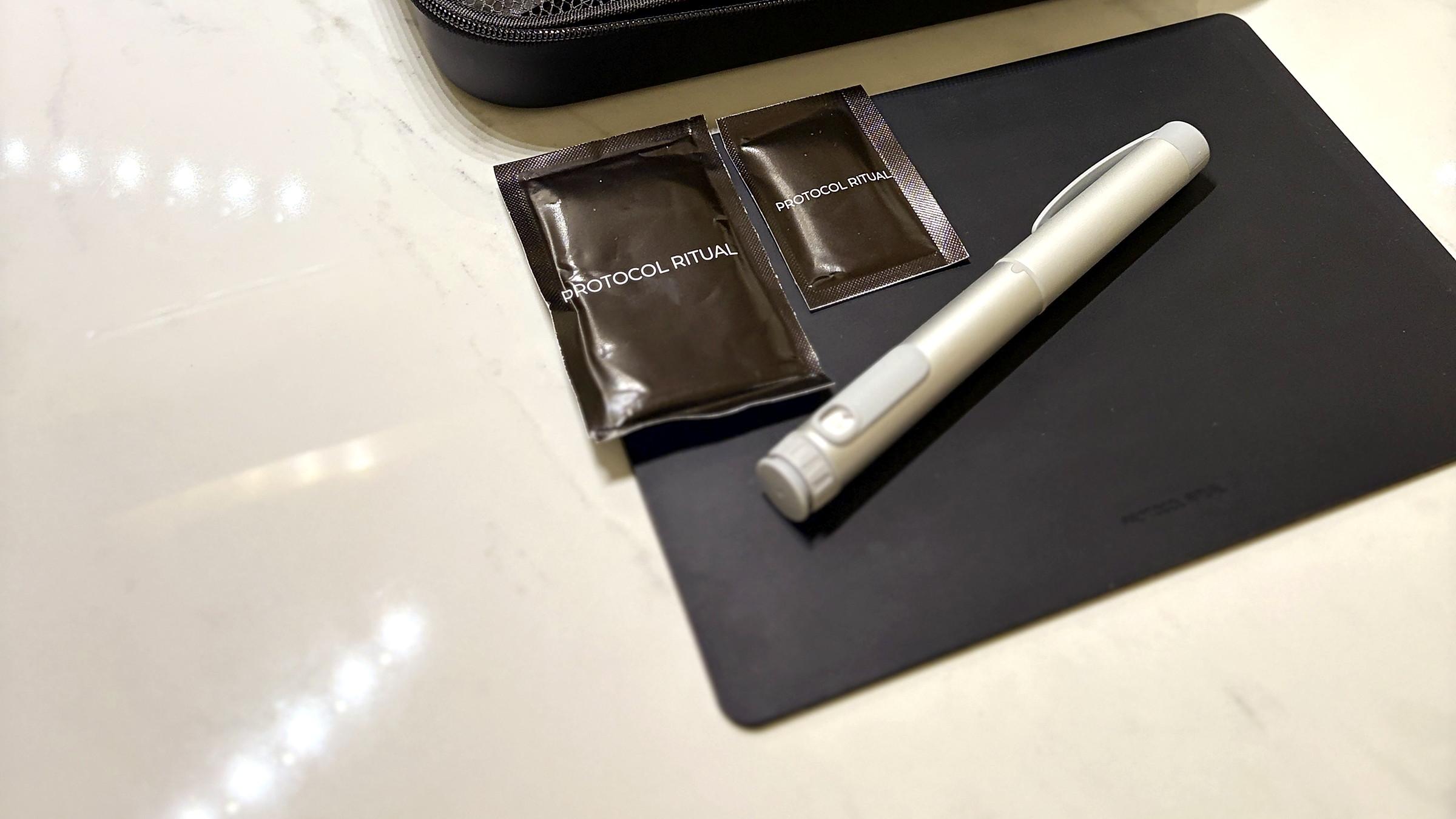
Traveling with a weekly injection can be simple, but only when every part of the routine has a defined place. A well-designed Ozempic travel case, Wegovy travel case, or GLP-1 travel case should do more than hold a pen. It should organize the medication, preparation supplies, documentation, and disposal plan you may need while helping protect everything from the crushing, shifting, and exposure that can happen in transit. The goal is not to build an oversized medical bag. It is to create a discreet, repeatable system that makes your routine feel as considered on the road as it does at home.
That distinction matters. Many products marketed to GLP-1 users are either generic medication pouches or insulated cooler bags. Those products may serve a specific purpose, but they do not always address the full preparation routine. Protocol Ritual is designed around organization, preparation, and discretion for at-home self-injectors, including people following GLP-1 protocols.
What Should Fit in a GLP-1 Travel Case?
The exact contents of your travel setup depend on the medication presentation you have been prescribed, the length of your trip, and the instructions provided by your healthcare professional or pharmacist. Some GLP-1 medications come in single-use pens. Others use multi-dose pens that may require separate pen needles. Product formats can also change over time, so always verify what applies to the specific device in your possession.
A practical GLP-1 travel case may need room for:
- Your prescribed injection pen or pens
- The original carton or pharmacy label, when practical
- Unused pen needles, when required by your device
- Alcohol prep pads
- A compact preparation surface
- A small supply of clean gauze or other provider-recommended materials
- A travel-sized sharps disposal solution
- Prescription documentation or a pharmacy printout
- A simple routine card or reminder note
Packing only the pen can leave the rest of the process scattered across multiple pockets. Pen needles may end up in a toiletry bag, alcohol prep pads in a backpack pocket, and documentation somewhere else entirely. That fragmentation creates unnecessary searching and makes it easier to forget a small but essential item.
A better system keeps related supplies together without forcing you to carry more than you need.
A GLP-1 Pen Needs Protection from More Than Temperature
Temperature is important, but it is not the only travel concern. A pen can also be exposed to pressure, impact, moisture, direct sunlight, dirt, and accidental activation.
A structured travel case can help create a physical barrier between your injection supplies and the rest of your luggage. That matters when bags are compressed in an overhead bin, pushed under an airplane seat, or packed tightly inside a vehicle.
Your case should help prevent the pen from:
- Rolling freely through a bag
- Being crushed beneath heavier items
- Coming into contact with loose liquids
- Being exposed to dirt or debris
- Sitting unprotected in direct sunlight
- Becoming mixed with unrelated toiletries or electronics
For pens with removable needles, the manufacturer may instruct users to remove and safely discard the needle after each injection rather than storing the pen with a needle attached. Current Wegovy prescribing information, for example, includes different storage and handling instructions depending on whether the patient has a single-dose device or a multi-dose FlexTouch pen. Follow the instructions for your exact presentation rather than assuming that all GLP-1 pens work the same way.
Does a GLP-1 Travel Case Keep Medication Cold?
Not necessarily.
A standard organizational case and a temperature-controlled medication carrier are different products. The current Protocol Ritual case does not include a cooling or cold-chain system. A dedicated cooling accessory is a future product being tested, but it is not part of the current case.
That means the case should never be treated as a refrigerator, cooler, insulated medication bag, or temperature-management device. Its purpose is to organize supplies, provide structure, support a clean preparation routine, and offer discretion.
When temperature control is required for your medication and travel conditions, use an appropriate solution recommended by your pharmacist, healthcare professional, or medication manufacturer. Do not assume that a case, insulated sleeve, hotel minibar, ice pack, or vehicle air conditioning automatically maintains the correct temperature.
Understand the Storage Instructions for Your Exact Pen
GLP-1 medications do not all share one universal storage rule. Instructions may differ by brand, device type, whether the pen has been used, and how long it will remain outside refrigerated conditions.
For example, current U.S. prescribing information states that new, unused Ozempic pens should be refrigerated between 36°F and 46°F. A pen in use may be stored for 56 days under the conditions described in the labeling. Ozempic should not be frozen, should be kept away from excessive heat and light, and should have its cap on when it is not being used.
Current Wegovy instructions vary by presentation. Wegovy single-dose pens are generally stored refrigerated, but the manufacturer states that, before cap removal, they may be kept between 46°F and 86°F in the original carton for up to 28 days when needed. The original carton helps protect the medication from light. The newer multi-dose FlexTouch presentation has its own handling instructions, including a different period after first use.
These examples are educational, not a substitute for checking your own prescription information. Before a trip:
- Read the current package insert or medication guide.
- Confirm which pen presentation you have.
- Ask your pharmacist what conditions apply during your itinerary.
- Clarify what to do if the medication becomes too warm, too cold, frozen, damaged, or exposed to light.
- Never use the appearance of the case as evidence that the medication remained within its required range.
A protective organizational case can reduce clutter and physical exposure, but it cannot verify temperature stability.
Why Carry-On Placement Usually Makes More Sense
Keeping essential medication in your carry-on gives you more direct control over it. Checked baggage can be delayed, lost, crushed, or separated from you during schedule changes.
A carry-on setup also makes it easier to:
- Present medication for screening when requested
- Keep the pen with you during delays or connections
- Avoid losing your entire supply with checked luggage
- Monitor where the case is stored
- Prevent the case from being buried beneath heavy items
TSA permits medically necessary medications in carry-on baggage. It recommends that medications be clearly labeled to make screening easier. Medically necessary liquids in quantities greater than the standard 3.4-ounce limit may also be carried in reasonable amounts, but they should be declared and removed for separate screening when required. The final decision at the checkpoint rests with the TSA officer.
International travel adds another layer. Security rules, prescription requirements, import restrictions, and documentation expectations can vary by country. Confirm the rules for your destination and every transit country before departure.
What Documentation Should You Bring?
TSA does not generally require prescription medication to be presented in a specific standardized container for domestic screening, but clearly labeled medication can make the process smoother. Your destination may have stricter requirements.
Depending on the trip, consider carrying:
- The original pharmacy label
- The original medication carton
- A copy of your prescription
- A brief letter from your healthcare professional
- Your pharmacy’s contact information
- The medication’s generic and brand names
- A copy of current storage instructions
Keep documentation close to the medication rather than in a separate checked bag. Digital copies are useful backups, but a printed copy may be easier to present when internet service is unavailable.
Do You Need to Pack Syringes or Pen Needles?
Many GLP-1 pens are supplied as self-contained devices, while others use separate disposable pen needles. Pack according to the exact product you were prescribed.
TSA states that unused syringes are allowed when accompanied by injectable medication. Travelers must declare them to security officers for inspection, and labeling is recommended to facilitate screening.
Do not carry loose needles at the bottom of a bag. Keep unused needles in their original packaging or a dedicated compartment. Used needles should go into an appropriate sharps container, not back into the compartment with clean supplies.
Before leaving, determine how you will dispose of used sharps at your destination. Hotels, airports, clinics, pharmacies, and local waste authorities may have different procedures. Never leave an exposed needle in a hotel trash can, airplane lavatory, public bin, or unsecured pouch.
Build a Travel Routine, Not Just a Packing List
The most useful travel case supports a repeatable sequence.
A simple travel routine might look like this:
- Choose a stable, private preparation area.
- Wash and dry your hands.
- Set down a dedicated preparation mat.
- Remove only the supplies needed for that session.
- Follow the medication’s Instructions for Use and your provider’s guidance.
- Place used sharps directly into the appropriate disposal container.
- Return remaining clean supplies to their assigned compartments.
- Confirm that the pen cap, original carton, and documentation are secure.
- Put the complete system back in your carry-on.
The purpose of the mat is to define a preparation space, not to sterilize a surface or make an injection medically safer. Protocol Ritual content focuses on organization and preparation and does not provide dosing, injection, or medical guidance. Clinical questions should always be directed to a qualified healthcare professional.
Discretion Matters When You Travel
Medication is personal. Your travel case does not need to announce its contents to everyone in an airport lounge, hotel room, shared rental, or office.
A discreet GLP-1 travel case should look intentional without looking clinical. It should keep supplies out of sight while remaining easy for the owner to access. This is especially valuable for people who travel with colleagues, share accommodations, or simply prefer to keep their healthcare routine private.
Discretion does not mean hiding medication from security personnel. It means avoiding unnecessary exposure during the rest of the trip.
Common GLP-1 Travel Packing Mistakes
Packing the Medication in Checked Luggage
Checked luggage may be delayed or lost, and you have less control over how it is handled.
Assuming Every Pen Has the Same Storage Rules
Ozempic, Wegovy, and other GLP-1 products may have different instructions. Device presentations within the same brand may also differ.
Treating an Organizational Case as a Cooler
The Protocol Ritual case does not cool its contents and should not be described or used as a cold-chain solution.
Placing Medication Directly Against an Ice Pack
Freezing can damage certain medications. Manufacturer instructions may specifically warn against freezing or placing a pen next to a cooling element. Ask a pharmacist how to arrange any medically necessary temperature-control system.
Forgetting a Disposal Plan
Used sharps should never be left loose in the case or discarded in ordinary public trash without following applicable disposal guidance.
Carrying More Supplies Than the Trip Requires
Overpacking creates clutter. Pack a reasonable quantity for the itinerary, plus a modest contingency supply based on guidance from your healthcare professional.
Removing All Identifying Packaging
A bare pen may take up less space, but the carton and pharmacy label can provide identification, storage information, and screening context. Keep original packaging when practical and when required by your destination.
What Makes a Better GLP-1 Travel Case?
A better case supports the entire routine instead of acting as an empty shell.
Look for a system that offers:
- Structured protection for the pen
- Defined areas for preparation supplies
- Space for alcohol prep pads
- A discreet exterior
- An easy-to-clean preparation mat
- Compact dimensions suitable for a carry-on
- Flexible organization for different trip lengths
- Enough separation to keep clean and used items apart
Cooling should be evaluated separately. When you need active temperature management, choose a purpose-built solution that matches the medication manufacturer’s instructions. The organizational case should complement that plan, not replace it.
Frequently Asked Questions
Can I bring an Ozempic pen on an airplane?
Yes. Prescription injectable medication is generally permitted in carry-on baggage. Keep it accessible, clearly labeled when possible, and be prepared to declare medically necessary supplies during screening.
Can I bring a Wegovy pen through TSA?
Yes. Medically necessary injectable medication is permitted, subject to security screening. Keeping the medication in its original carton or with a pharmacy label can help simplify identification.
Should a GLP-1 pen go in a carry-on or checked bag?
A carry-on is generally the more practical choice because it keeps the medication under your control and reduces the risk of separation caused by delayed or lost checked luggage.
Does the Protocol Ritual case keep a GLP-1 pen refrigerated?
No. The current Protocol Ritual case does not contain a cooling or cold-chain system. It is an organizational and preparation system. Follow the manufacturer’s instructions and use a separate, appropriate temperature-management solution when required.
How long can Ozempic remain outside the refrigerator?
The current manufacturer labeling provides specific conditions for a pen in use, including a 56-day period. Consult the instructions supplied with your pen or ask your pharmacist before traveling because storage conditions and labeling can change.
How long can Wegovy remain outside the refrigerator?
It depends on the Wegovy presentation. Current labeling includes different instructions for single-dose pens and multi-dose FlexTouch pens. Check your exact device and current medication guide rather than relying on a general rule.
Can I put my GLP-1 pen directly on ice?
Do not place a pen directly against ice or a frozen cooling element unless the manufacturer or your pharmacist specifically instructs you to do so. Some GLP-1 medications must not be frozen.
What should I do if my pen becomes too hot or freezes?
Do not guess about whether it is still usable. Contact your pharmacist, prescribing healthcare professional, or the manufacturer using the contact information in the medication guide.
Should I travel with the original medication box?
When practical, yes. Original packaging can provide identification, instructions, light protection, and helpful documentation during security screening or international travel.
Can I store used needles in the travel case?
Used needles should be placed directly into an appropriate sharps disposal container. They should not be returned loose to the clean-supply compartments.
Bring a Better Standard to Your Travel Routine
Protocol Ritual was built for people who take their routine seriously and want the tools around it to reflect that. We are here for daily and weekly users who are tired of piecing together a process from random supplies and pretending that messy setups are good enough.
With a discreet premium case, a real weighted prep mat, and custom-branded alcohol prep pads included, Protocol Ritual is the first all-in-one kit designed to support the full ritual from preparation through organization. The current system does not provide cooling or cold-chain temperature control, but it gives the rest of your travel routine a defined, dependable place.
Visit Protocol Ritual to join the launch and be among the first to experience a better standard for daily protocol.