

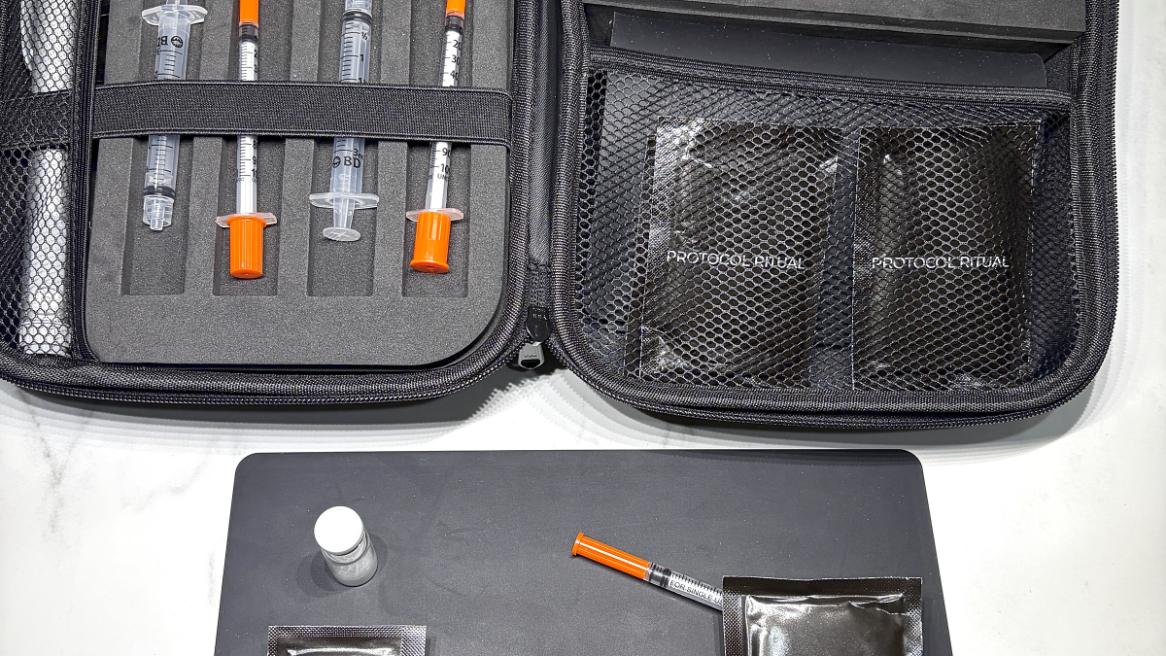
If you’re managing a weekly TRT protocol, a daily peptide stack, or a GLP-1 regimen, you’ve probably already improvised some version of a storage system: a zip pouch, a pencil case, or a corner of your medicine cabinet. You might even be carrying your syringes in a grocery bag or a transparent pharmacy sack just to get them home. This comparison evaluates whether the Protocol Ritual Kit at $99.99 is a tangible functional upgrade over those improvised setups, or whether it’s a premium product solving a problem that a $12 organizer already handles well enough. The answer depends almost entirely on what your routine actually demands.
Any container can hold a syringe. Most fail the workflow. What generic cases can’t do is support the full workflow: protecting fragile glass vials during transport, providing a clean prep surface wherever you happen to be, and creating the kind of organized, repeatable environment that makes a twice-weekly injection feel less like a clinical interruption and more like a manageable part of your day.
The Reality of Self-Injection Routines and the Need for Organization
The Psychological and Physical Friction of Home Injections
Self-injection compliance is a more fragile thing than most people expect when they start a protocol. The physical act is simple enough after a few weeks, but the surrounding friction, hunting for supplies, prepping on whatever surface is available, and second-guessing whether something is still sterile, compounds over time. That friction is worth taking seriously.
Studies document the scale of needle-related anxiety among self-injectors. According to a Journal of Advanced Nursing study on needle phobia, 63.2% of 2,098 participants reported experiencing needle phobia. For people already managing that baseline anxiety, a disorganized prep environment doesn’t just slow things down; it amplifies the mental weight of every injection day. When you can’t find your alcohol swabs, when your vial rolls off the counter, or when you’re not sure if the needle you grabbed is the right gauge, the mental load of the task grows disproportionately. Your medicine shouldn’t sit scattered across the bathroom counter with visible prescription labels exposed to anyone who walks in.
A structured setup doesn’t eliminate needle anxiety, but it removes the environmental variables that feed it. Knowing exactly where everything is, and having a designated space to work, shifts the experience from reactive scrambling to a predictable sequence.
The Hidden Hygiene Risks of Improvised Workspaces
The hygiene dimension of home injection prep is where improvised setups most visibly fail. Bathroom counters, kitchen tables, and nightstands are not clean fields: they carry bacterial contamination from everyday use, and no amount of general tidiness changes that. Placing a sterile syringe on a bathroom counter, even briefly, introduces a contamination risk that a clinical setting would never accept.
The World Health Organization’s guidelines on best practices in phlebotomy specify that injections must be prepared in a designated clean area free of clutter, and that surfaces must be cleaned with 70% alcohol and allowed to dry completely before use. Most home injectors are not doing this with their bathroom counter before every prep session. The gap between clinical hygiene standards and the average improvised home setup is wider than most people acknowledge.
A portable, dedicated prep surface changes this equation. It isolates the workspace. When the surface is non-porous, purpose-built for sanitization, and deployed only during prep, maintaining a clean field becomes a realistic part of the routine rather than an aspirational one.
Establishing a predictable, structured environment is the first practical step toward reducing both prep anxiety and contamination risk. Building a consistent injection day routine around a dedicated workspace, using the same location, same sequence, and same tools in the same positions, shifts an anxiety-prone task into something your nervous system can anticipate and settle into.
Protocol Ritual vs. Generic Cases: A Side-by-Side Comparison
Improvised Storage vs. Purpose-Built Systems
Cheap makeup bags and plastic pencil boxes do one thing adequately: they keep loose supplies from scattering. For someone who injects infrequently, stores everything at home, and has a stable, dedicated prep area, that basic containment may genuinely be sufficient. There’s no reason to oversell the problem.
Where generic cases break down is under the conditions that define most real injection routines: travel, irregular schedules, multi-component protocols with glass vials, and the need for a clean prep surface away from home. A cosmetic bag offers no physical protection for a 10ml glass vial in checked luggage. A plastic pencil box has no mechanism for keeping needles separated from vials, no prep surface, and no design consideration for the specific geometry of injection supplies. These are not minor inconveniences; they are the exact failures that lead to broken vials, contaminated supplies, and missed doses. They disrupt your routine.
A purpose-built system integrates secure storage and a sterile workspace into a single, unified workflow.
Material Quality and Safety Standards
The material composition of a storage case is a functional safety consideration, not a marketing detail. Cheap, unverified plastics can off-gas volatile compounds, particularly when stored in warm environments like a car glove compartment or a checked bag in a cargo hold. When those plastics are in direct contact with sterile syringes or unsealed vials, the contamination risk is real, even if patients rarely discuss it.
Materials that undergo independent safety testing, specifically SGS certification against the US FDA food-contact standard and Germany’s LFGB standard, guarantee that no harmful plasticizers, BPA, or phthalates will migrate onto your supplies during storage. They are also engineered to withstand repeated exposure to 70% isopropyl alcohol without degrading, cracking, or discoloring, which matters for a case you are sanitizing before every use.
For a detailed look at how specialized organizers compare across the market, the peptide case comparison covers the key functional differences between purpose-built systems and standard utility cases in depth.
- Material Safety: SGS-tested, food-grade materials (US FDA and German LFGB compliant) vs. unverified, potentially toxic plastics.
- Workspace Integration: Built-in, foldable prep mat vs. prepping directly on contaminated household surfaces.
- Discretion: Sleek, neutral hardshell exterior vs. obvious clinical medical cases or messy cosmetic bags.
- Physical Protection: Custom-molded compartments and shock-absorbent EVA shell vs. loose supplies shifting and colliding during transport.
Upgrade Your Injection Setup
The Protocol Ritual Kit, priced at $99.99, includes a hardshell EVA case, a foldable silicone prep mat, and custom alcohol prep pads. Designed for the full injection preparation workflow, not just containment.
The kit is designed for storage and preparation only. It does not contain medications, syringes, or medical supplies.
Analyzing the Design: Materials, Safety, and Usability
The Engineering Behind the Silicone Prep Mat
The integrated silicone prep mat is the feature that most clearly separates Protocol Ritual from every generic case in the category. It folds flat inside the case during transport and unfolds into a dedicated prep surface wherever you are: a hotel bathroom, an office, or a gym locker room. The surface is non-porous, which means bacteria and contaminants do not penetrate it the way they do fabric or standard plastic. A wipe-down with 70% isopropyl alcohol before each use brings it into compliance with the WHO’s sanitization standard in seconds.
The mat’s molded slots are designed around the actual geometry of injection supplies: vials sit upright and stable, syringes rest in dedicated channels, and prep pads have a designated position. Nothing rolls. Nothing migrates into contact with something it shouldn’t touch.
Certified Material Safety and Longevity
SGS certification is the relevant benchmark here. Protocol Ritual’s materials pass both the US FDA food-contact standard and Germany’s LFGB standard, which are among the more stringent independent material safety tests available. What that certification means in practice is that independent labs verified that the silicone and case materials are free of BPA, phthalates, lead, and other harmful compounds that cheaper plastics routinely contain.
Durability matters as much as initial safety for a case used daily or several times per week. Materials that degrade under repeated alcohol exposure will eventually crack, discolor, or develop surface irregularities that compromise the clean field. The certified materials in Protocol Ritual are built to maintain their integrity through years of regular sanitization, which is the actual usage pattern for someone on a long-term TRT or peptide protocol.
The injection prep mat functions as a physical barrier between your sterile supplies and whatever surface you’re working on: a distinction that matters most when you’re away from home. A hotel bathroom counter, a gym surface, or a work desk all carry contamination that a non-porous, sanitized silicone mat interrupts completely. The mat doesn’t just organize your supplies; it creates a defined, defensible clean field in an otherwise uncontrolled environment.
FDA and LFGB compliance is not a box-checking exercise for a product used in direct contact with medical supplies. These certifications confirm that no harmful chemicals or plasticizers will migrate from the case material onto your syringes or vials during the weeks or months they spend in storage together. For anyone on a long-term protocol, the cumulative exposure question is worth taking seriously, and certified materials answer it definitively.
- Hardshell EVA Exterior: Protects fragile glass vials from physical impact and light exposure during transport.
- Custom-Molded Compartments: Keeps syringes, needles, and vials in fixed positions, eliminating contact between components.
- Foldable Silicone Prep Mat: Deploys instantly as a clean, sanitizable workspace anywhere.
- Compact Footprint: Sized to fit a standard backpack, carry-on, or desk drawer without occupying disproportionate space.
Portability and Discretion: Managing Your Routine on the Go
Traveling with Injectable Medications
Traveling with syringes and glass vials introduces a specific category of stress that people on home injection protocols know well. TSA checkpoints, hotel room prep, the question of whether a vial survived checked luggage: these are not hypothetical concerns. A loose collection of supplies in a cosmetic bag offers no protection against the physical forces a checked bag experiences, and no organizational structure for the rushed prep session in a hotel bathroom at 6 a.m.
A dedicated hardshell case changes the travel calculus. All components are in one place, accounted for before you leave and immediately accessible when you arrive. The EVA shell absorbs impact that would shatter an unprotected glass vial. Light-sensitive medications, as certain peptides and hormones degrade under UV exposure, benefit from the case’s opaque exterior, which blocks ambient light during transport in a way a clear plastic bag never could.
The Power of Discreet Design
No case. No system. No dignity. That is the reality for many who leave clinical clutter on the counter. Protocol Ritual’s exterior carries no medical branding, no clinical iconography, and no visual signal that the case contains anything other than electronics or travel accessories. For people managing hormone therapy, TRT, or peptide protocols in shared living situations, professional environments, or public spaces, that discretion is not a cosmetic feature: it is a practical privacy protection.
The case reads as a premium tech organizer or travel accessory. It does not invite questions. It does not mark its owner as someone managing a medical condition. That psychological relief, meaning the ability to set your kit on a desk or pull it from a bag without self-consciousness, reduces the clinical weight of the routine in a way that’s genuinely difficult to quantify but easy to appreciate once you’ve experienced it.
Take Your Routine Anywhere
The Protocol Ritual Kit, priced at $99.99, travels as discreetly as it stores. It offers hardshell EVA protection, a foldable silicone prep mat, and a compact footprint designed for the realities of life on a long-term injection protocol.
Does not contain medications, syringes, or medical supplies.
Is a Specialized Organizer Worth the Investment?
Evaluating the Cost vs. Value Proposition
At $99.99, Protocol Ritual is not a casual purchase. It is worth being direct about that. If your protocol is stationary, infrequent, and your prep environment is already clean and stable, a generic case may serve you adequately. The honest answer is that not everyone needs this level of system.
For people who inject multiple times per week, travel regularly, manage glass vials alongside syringes and multiple needle gauges, or find that prep anxiety is a recurring feature of their routine, the functional equation shifts. A broken vial of a compounded peptide or hormone can cost more than the kit itself. The cognitive relief of a fully organized, purpose-built system, knowing exactly where everything is and having a clean field ready to deploy in sixty seconds, is harder to price but real in its effect on compliance and routine quality. A generic case that you replace every year because it cracks, loses its zipper, or fails to protect a vial doesn’t save money over a three-year protocol.
Who Benefits Most from the Protocol Ritual Kit
The case for a dedicated system is strongest for specific patient profiles, and it is worth being precise about who that includes rather than overstating the universal need.
- Long-term patients on TRT, peptide therapy, HRT, or GLP-1 regimens who inject weekly or more frequently.
- Frequent travelers, including professionals or vacationers who need to transport sensitive medications safely and discreetly without reorganizing their entire luggage setup.
- Anxious injectors who experience needle phobia or routine disruption and benefit from a highly structured, calming preparation environment.
Evaluate Your Current Setup
Ready to upgrade? Explore the at-home injection organization system and see how Protocol Ritual structures the full preparation workflow.
Improvised setups are functional for basic containment, and there is no reason to pretend otherwise. What they do not provide is the hygiene infrastructure, physical protection, and mental structure that a long-term self-injection routine demands. For someone three years into a TRT protocol who has broken two vials in luggage, prepped on a bathroom counter they know they shouldn’t be using, and spent more time than they would like hunting for supplies on injection morning, the $99.99 investment is less about the product and more about finally building a system that matches the seriousness of the commitment.
Frequently Asked Questions About Injectable Medication Organizers
How do I clean and sanitize the silicone prep mat?
The medical-grade silicone prep mat is designed for simple sanitization between uses. Wipe the surface with 70% isopropyl alcohol before and after each prep session and allow it to air dry completely before folding the mat back into the case. For a deeper clean after extended use, the mat can be washed with warm water and mild soap. For additional care guidance, the Protocol Ritual Kit guides cover maintenance and setup in detail.
What are the physical dimensions of the Protocol Ritual Kit?
The kit is designed for portability, measured to fit comfortably into standard backpacks, carry-on luggage, or desk drawers while still providing organized space for all essential injection supplies.
Does the kit offer temperature control or cooling for medications?
Protocol Ritual is designed for organization, physical protection, and hygienic preparation, not active temperature management. If your medications require refrigeration, keep them in a dedicated cold storage device during transit and transfer them to the kit’s compartments immediately before preparation. The kit’s role begins at the prep stage, not the storage-temperature stage.
Can the custom-molded compartments accommodate different vial sizes?
Yes. The flexible silicone compartments are engineered to hold standard 10ml vials as well as smaller peptide or hormone vials securely, keeping each one stable and protected regardless of size variation within that range.
What makes food-grade silicone safer than standard plastics?
Food-grade silicone is non-porous, hypoallergenic, and free from BPA, phthalates, and lead: the compounds most commonly associated with chemical migration in cheaper plastics. Unlike standard plastics, it doesn’t off-gas or degrade when exposed to repeated alcohol sanitization, which means the prep surface remains chemically inert and structurally stable over years of regular use. For anyone storing sterile medical supplies in direct contact with the material, that chemical stability is the core safety argument.
Type 1 diabetes, hormone replacement, or peptide therapies require a long-term commitment, and the tools you build that commitment around matter more than most people initially expect. The difference between a routine that feels manageable and one that accumulates friction with every injection day often comes down to whether your environment is working with you or against you. A purpose-built system doesn’t change the medical reality of your protocol, but it changes the experience of living inside it: replacing the improvised, slightly anxious scramble with something that feels deliberate and under control.
Protocol Ritual was built from that premise. If you want to understand the thinking behind the product, our mission and values lay out the reasoning directly.
Build a Setup That Matches Your Commitment
The Protocol Ritual Kit at $99.99 is the complete injection preparation system: hardshell EVA case, foldable silicone prep mat, and custom alcohol prep pads. Designed for the full workflow, not just the storage problem.
Does not contain medications, syringes, or medical supplies.