

Your doctor handed you a prescription, a box of syringes, and left you to figure out the rest. A prescription tells you what to take. It doesn’t tell you how to carry it. Now you are managing a home-injection protocol in your kitchen or bedroom, trying to make sense of delicate biological compounds without a lab technician standing over your shoulder to tell you if a temperature change has ruined your vial. Peptides are highly sensitive molecules. Storing them incorrectly does not just waste your financial investment; it compromises their medical potency. We translate rigid, laboratory-grade stability science into a practical daily structure, helping you protect your medication and clear the clinical clutter from your space.
The Science of Peptide Instability: Why Proper Storage Matters
Peptide bonds hold these chains of amino acids together. Unlike small-molecule drugs, these biological compounds operate within a narrow environmental tolerance. When conditions drift outside that range, the chemistry turns against you. Degradation moves through several simultaneous paths: oxidation, deamidation, hydrolysis, decomposition, and polymerization. Each one chips away at the active compound until what remains in the vial no longer resembles your original prescription, according to peer-reviewed pharmaceutical stability research published in PMC. The damage is not always visible. A reconstituted vial can look identical before and after a significant temperature excursion, which makes improper storage easy to overlook until the treatment fails.
A temperature excursion, defined as any deviation from labeled storage conditions for any duration, whether during transit or in your home refrigerator, accelerates this breakdown. Manufacturing facilities use automated climate controls and Good Manufacturing Practices to prevent excursions at every stage of production. Once the medication crosses your threshold, that responsibility transfers entirely to you. There is no alarm, no automated log, and no technician checking the readings. You are on your own. Understanding the degradation mechanisms behind your specific therapy, whether you are following Mounjaro storage guidelines or managing a BPC-157 protocol, is the foundation of every other storage decision you make. Reviewing the Mounjaro storage guidelines alongside the regulatory considerations that govern peptide therapeutics more broadly gives you the context to make those decisions with confidence.
Temperature Control: Navigating Refrigerator and Freezer Standards
The United States Pharmacopoeia establishes the standardized definitions for pharmaceutical storage environments across the United States. Those definitions are more precise than most home users realize. Precision matters here. “Keep refrigerated” is not a casual suggestion: it maps to a specific numerical range with real consequences for deviation. Aligning your domestic storage with these ranges, rather than trusting an uncalibrated refrigerator dial, is the most critical step you can take to protect your medication.
The USP defines four storage categories relevant to home peptide management (per USP pharmaceutical storage standards):
- Freezer (-25°C to -10°C): Use this range primarily for long-term storage of dry, lyophilized powder vials before reconstitution. This sub-zero range locks the compound in a stable lattice and extends shelf life significantly.
- Cold / Refrigerator (2°C to 8°C): The critical range for cold chain biologicals and all reconstituted liquid peptides. Keeping your household refrigerator within these exact limits slows microbial growth and preserves structural integrity. Most home refrigerators run warmer than users assume; a calibrated thermometer placed on the shelf where your vials sit is worth the five dollars it costs.
- Cool (8°C to 15°C): A transitional range for specific medications that require mild chilling but must not approach freezing temperatures. Few home users will encounter this category, but it is worth knowing it exists so you do not assume every peptide belongs at the coldest possible setting.
- Controlled room temperature (20°C to 25°C): This range sits between 20°C and 25°C, with temporary shifts permitted between 15°C and 30°C. While some dry peptides can tolerate this range temporarily during transit, reconstituted liquids degrade rapidly under these conditions and should never be left at room temperature for extended periods.
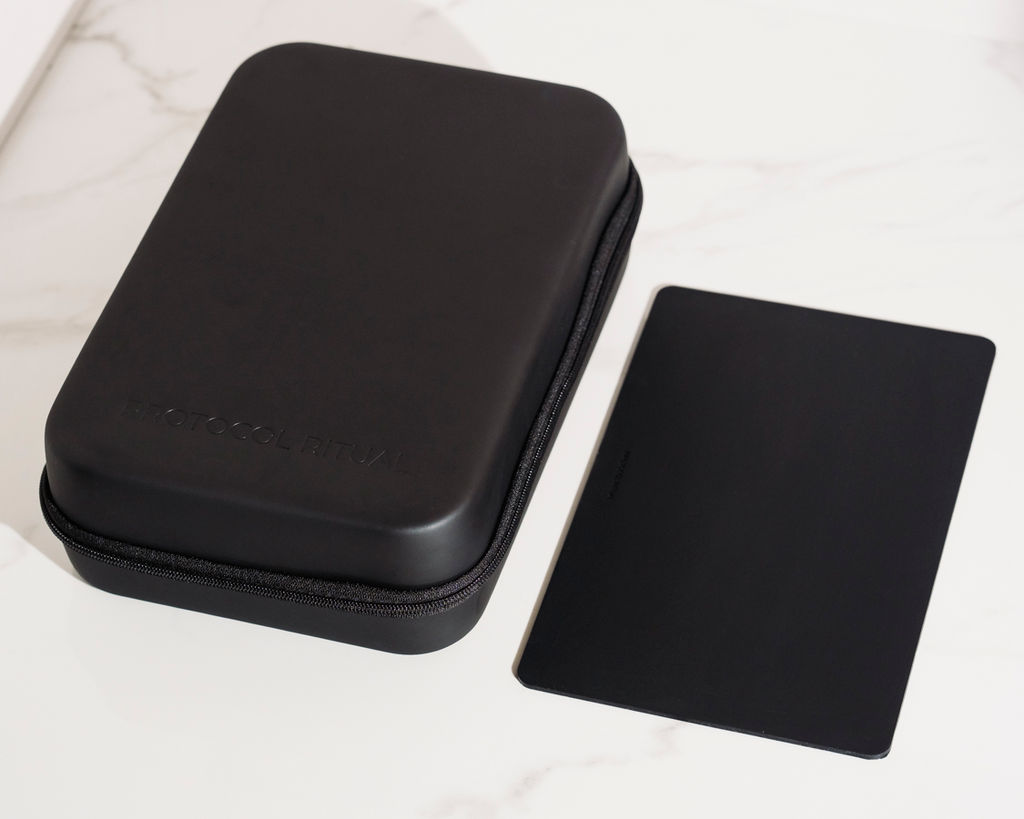
If you are tired of carrying syringes in a paper bag or letting your clinical supplies scatter across your counter, it is time to establish a real system. The Protocol Ritual Kit ($99.99) provides the physical architecture your prescription did not come with: a discreet, hardshell EVA case that organizes your vials, syringes, and prep pads in one secure place, protecting your supplies from physical damage and ambient light. Please note: We designed the Protocol Ritual Kit for storage and preparation organization only; it does not include active cooling mechanisms or medication.
Lyophilized vs. Reconstituted Peptides: Two Distinct Storage Phases
The physical state of your peptide determines its environmental sensitivity at every stage of your protocol. Manufacturers freeze-dry lyophilized drug products to extend the shelf life of sensitive active ingredients, but that process does not make them indestructible; it makes them stable under a specific, narrow set of conditions. In their dry powder state, the peptide bonds lock into a stable crystalline lattice. Any exposure to moisture or premature temperature spikes during storage can cause product collapse or melt-back, ruining the compound before you have even introduced a diluent. Temperature excursions during the initial freezing phase can cause incomplete crystallization or uneven moisture distribution, while excursions during the drying phase carry the risk of that collapse directly (per USP pharmaceutical stability research). These are not theoretical edge cases: they are the documented failure modes of lyophilized biologicals stored in environments without active monitoring.
Once you introduce bacteriostatic water, the compound enters a fundamentally different phase. The clock starts ticking. In its reconstituted liquid state, the peptide molecules are highly reactive and far more fragile than they were as a powder. Hydrolysis and oxidation proceed continuously from the moment of reconstitution; cold storage between 2°C and 8°C slows those reactions but does not stop them. Whether you are managing daily injections at home or traveling with peptides across time zones, keeping these two phases distinct in your handling habits is not optional: it is the difference between a functional vial and an expensive waste.
The practical rules for each phase differ enough to be worth stating plainly:
- Lyophilized (powder) phase: You can typically store these in the freezer (-25°C to -10°C) for extended preservation, or in the refrigerator (2°C to 8°C) according to manufacturer instructions. Protect from moisture at all times; for hygroscopic compounds, relative humidity in your storage area must stay below 40% to 60% depending on the compound’s sensitivity (per USP pharmaceutical stability research).
- Reconstituted (liquid) phase: Never freeze reconstituted peptides. Freezing a reconstituted peptide causes lattice position dislocation and mechanical stress from ice crystal formation, destroying the biological structure at the molecular level (per USP pharmaceutical stability research). Once you have mixed a vial, the freezer is no longer an option.
- Reconstitution timing: Timing matters as much as temperature once a vial is reconstituted. Most reconstituted peptides remain stable for several weeks to 30 days under proper refrigeration, depending on the compound and the manufacturer’s guidance. Tracking your reconstitution date on the vial itself, using a piece of medical tape and a marker, is a simple habit that removes all ambiguity.
Protecting Peptides from Light, Moisture, and Physical Agitation
Temperature gets most of the attention, but ambient light and ultraviolet radiation act as separate triggers for degradation. UV exposure accelerates the oxidation of sensitive amino acid residues within your vials, and the damage accumulates faster than most people expect. If you leave a vial on a brightly lit countertop near a south-facing window for a few hours, it will not match the condition of one that stayed in a dark drawer. Amber glass vials offer some protection, but they are not a substitute for keeping your compounds away from direct light entirely. If your storage area receives significant sunlight at any point in the day, that is a problem worth solving before it costs you a vial.
Moisture is the second environmental threat that home users underestimate. High relative humidity can compromise vial seals and degrade lyophilized powders when the environment exceeds 40% to 60% humidity, depending on the compound’s hygroscopic nature (per USP pharmaceutical stability research). Bathrooms are a particularly poor storage location for this reason: the humidity fluctuations from showers alone can push well above safe thresholds. A bedroom drawer or a dedicated cabinet in a climate-controlled room is a far more stable environment than the medicine cabinet most people default to.
Physical agitation rounds out the triad of non-temperature threats. Never shake your vials. Shaking a reconstituted vial to mix it, which is the instinct most people bring from mixing protein powder or salad dressing, can shear the delicate peptide bonds and render the treatment ineffective. Swirling the vial slowly is the correct technique: rotate the vial between your palms until the solution clears, and never vortex or shake it. The difference in outcome between these two approaches is not subtle.
Establish a clean, dedicated space for your home-injection protocol. The Protocol Ritual Kit ($99.99) includes a medical-grade, foldable silicone prep mat that provides a sanitizable surface anywhere in your home, protecting your vials from contamination. The hardshell EVA case shields your sensitive compounds from ambient light and physical drops. Order your Protocol Ritual Kit today to bring professional structure and restored dignity to your daily protocol.
Establishing a Safe Home Storage and Preparation Routine
The gap between knowing the correct storage parameters and actually maintaining them in a lived-in home is where most protocols fall apart. People reorganize refrigerators, clutter counters, and push the vital vial to the door to make room for leftovers. Building intentional habits around your storage environment closes that gap before it opens. Habits protect your investment.
- Map your refrigerator: Do not store your peptide vials in the door or against the back wall. The door experiences temperature swings every time it opens, and the back wall risks freezing the liquid when the compressor cycles. A stable, central drawer or dedicated shelf away from both extremes is the correct location.
- Monitor actively: Use calibrated temperature and humidity data loggers placed at the warmest spots in your storage area to track and prevent excursions (per USP pharmaceutical stability research). Consumer-grade digital thermometers with min/max memory are inexpensive and remove any ambiguity about whether your refrigerator is actually holding 2°C to 8°C.
- Sanitize your prep zone: Before reconstituting or drawing a dose, clean your hands and wipe down your prep surface. A dedicated, non-porous mat prevents environmental contamination and gives you a consistent, repeatable workspace.
- Build a structured injection day routine: Minimizing the time your vials spend outside cold storage reduces heat exposure on every injection day. A repeatable sequence of retrieve, prep, inject, and return keeps the vial out of ambient temperature for minutes rather than the half-hour it can drift to when the process is unstructured.
By integrating these habits into your daily life, you bridge the gap between the doctor’s office and your home. The anxiety around whether your medication is losing potency, that low-grade background worry that follows every injection day, largely dissolves when you maintain and monitor a consistent storage environment.
Frequently Asked Questions About Peptide Storage
Do I need to store my peptides in the refrigerator?
Yes. To maintain stability and prevent chemical degradation through pathways like hydrolysis and oxidation, you must keep reconstituted liquid peptides in a cold refrigerator environment between 2°C and 8°C (per USP pharmaceutical stability research). Lyophilized powders are also highly sensitive to temperature fluctuations and benefit from refrigeration or freezer storage depending on the manufacturer’s labeled instructions. The refrigerator is not a precaution: it is a requirement for maintaining the compound you paid for.
How long will my peptide last in the fridge?
The shelf life depends on the specific compound and its physical state. Lyophilized powders stored correctly in the freezer or refrigerator can remain stable for months or, in some cases, years. Once reconstituted, the timeline shortens considerably: liquid peptides are generally stable for several weeks to 30 days under proper refrigeration, though the exact window varies by compound and manufacturer guidance. Tracking the reconstitution date on each vial removes the guesswork entirely.
Which peptides should not be refrigerated?
Almost all reconstituted peptides require cold storage, but the more important principle is this: always follow the manufacturer’s or compounding pharmacy’s labeled instructions rather than assuming a universal rule applies (per USP pharmaceutical stability research). Some formulations include stabilizers that alter their cold-tolerance profile, and reconstituted peptides, regardless of compound, must never be frozen. When the label and general guidance conflict, the label wins.
How long can BPC-157 stay unrefrigerated?
In its lyophilized powder form, BPC-157 can tolerate controlled room temperature (20°C to 25°C) for short periods during transit without significant degradation (per USP pharmaceutical stability research). Once reconstituted, that tolerance narrows sharply. Leaving reconstituted BPC-157 unrefrigerated for more than a few days will accelerate degradation through oxidation and hydrolysis, reducing potency in ways that are not visible to the eye. Transit tolerance is not the same as storage tolerance: the two should not be conflated.
What happens if I leave my peptides unrefrigerated?
Exposing peptides to room temperature or elevated heat constitutes a temperature excursion. That excursion accelerates chemical degradation through oxidation and deamidation, resulting in a measurable loss of active assay, an increase in impurities, and ultimately a complete loss of therapeutic efficacy (per USP pharmaceutical stability research). The compound may still look clear and intact in the vial. There is no reliable visual indicator of degradation, which is precisely why the storage conditions matter so much: by the time something looks wrong, the damage has long since been done.
Order the Protocol Ritual Kit Today
Managing a home-injection protocol can feel overwhelming when the tools and guidance do not arrive with the prescription. Understanding the science behind temperature, light, and timing gives you a concrete framework to work from: not a set of anxious rules to memorize, but a logical structure that makes the right choices obvious. At Protocol Ritual LLC, our position is that managing your health should not come at the expense of your privacy or peace of mind. SGS independently tests the materials in our products, which pass both the US FDA food-contact standard and Germany’s LFGB standard, so the surfaces your medication touches meet the same safety threshold as your supplies. Learn more about Protocol Ritual and how we are helping patients restore dignity to their home care.
Take control of your home-injection protocol today. Order the Protocol Ritual Kit ($99.99) to securely organize, protect, and conceal your sensitive supplies.